Being organically visible in ChatGPT means your brand appears as a source or recommendation in ChatGPT's answers, and it is completely independent of advertising. This work is called GEO (Generative Engine Optimization) or AEO (Answer Engine Optimization). It rests on three things: your site being open to OpenAI's search crawler, content structured to answer questions clearly, and your brand being mentioned consistently in trusted sources.
The difference between ads and organic visibility
There are two separate ways a brand can appear in ChatGPT:
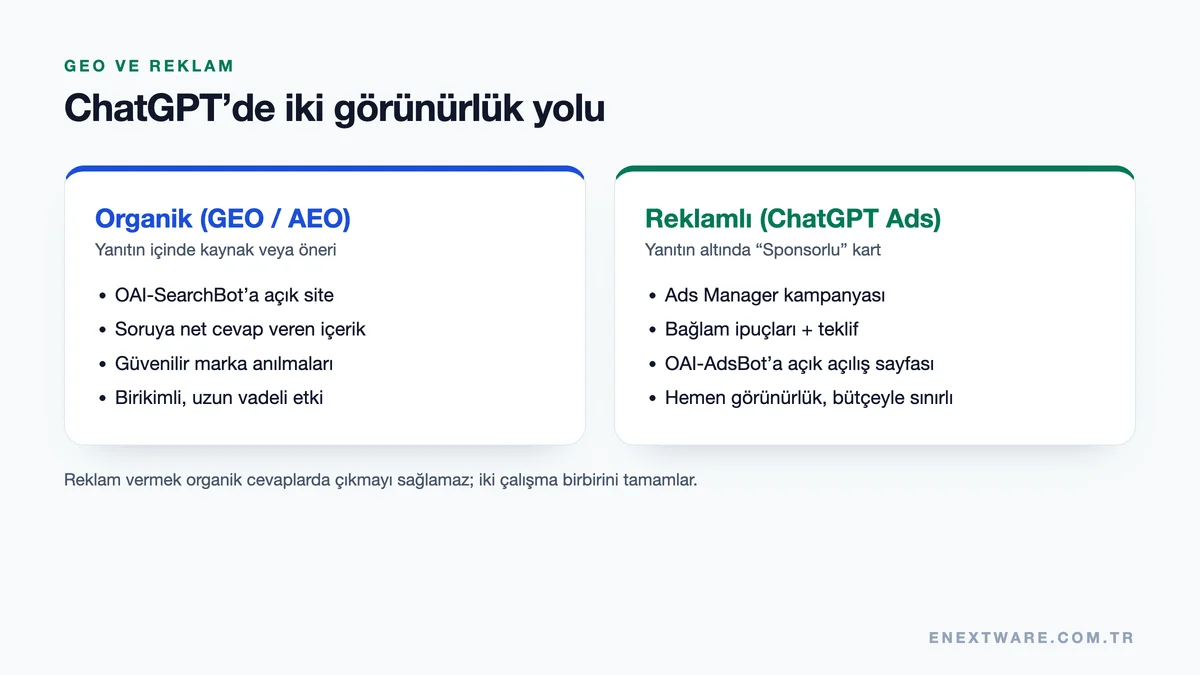
| ChatGPT Ads | Organic visibility (GEO/AEO) | |
|---|---|---|
| Where does it appear? | A "Sponsored" card below the answer | Inside the answer, as a source or recommendation |
| How is it earned? | Campaign and budget in Ads Manager | Content, technical access, brand authority |
| Who sees it? | Free and Go users | All users |
| Cost | Per click or per impression | Effort and time |
| Duration of effect | Stops when the budget runs out | Cumulative, long-term |
OpenAI states that ads do not affect ChatGPT's answers and are kept separate from them. Advertising does not get you into organic recommendations; the two are separate efforts and deliver the strongest results when run together. For the ad side, see our how to advertise on ChatGPT guide.
1. Technical access: don't block OAI-SearchBot
ChatGPT's search feature discovers web content with a crawler called OAI-SearchBot. If your site is closed to this crawler, your chances of being shown as a source in ChatGPT search results drop sharply.
| Crawler | What is it used for? | Recommendation |
|---|---|---|
| OAI-SearchBot | ChatGPT search results | Allow |
| OAI-AdsBot | Ad landing page checks | Mandatory if you advertise |
| ChatGPT-User | Opening a page the user requests | Allow |
| GPTBot | Model training | A separate decision; blocking it does not directly block visibility in search |
Checklist:
- Allow OAI-SearchBot in your robots.txt file.
- Check that Cloudflare or similar security layers are not blocking these bots by mistake.
- Don't put important content only on pages that load via JavaScript alone, require a login or sit inside a PDF.
2. Content structure: a clear answer to the question
AI assistants prefer passages that give the clearest, most reliable answer to a question. That is why the way content is written matters:
- A clear definition in the first paragraph: The page's topic should be answered directly in a single 40–60 word paragraph.
- Question-style headings: Headings such as "What is X?", "How much is X?" and "How do you do X?" match user questions.
- Tables and lists: Comparisons, price items and steps should be given as tables or lists.
- Concrete data and sources: Figures should come with their source, and the update date should be stated.
- Frequently asked questions: Short, clear answers to real user questions at the end of every page.
- One page, one intent: One comprehensive page instead of several thin pages answering the same question.
3. Brand signals: being mentioned consistently and credibly
When AI models recommend a brand, they look at how the brand is mentioned across the web. This is an extended version of link authority in classic SEO:
- Your company name, address, phone number and service description being identical on all platforms
- Being listed in industry directories, on news sites and with professional associations
- Up-to-date, genuine reviews on Google Business Profile and review platforms
- Openly published reference projects and case studies
- A visible founder and expert team (author pages, professional profiles)
4. Structured data and machine readability
Schema.org structured data (Organization, Service, FAQPage, Article, BreadcrumbList) makes it easier for machines to understand what your content is about. Some sites also publish an llms.txt file to offer a site summary to AI tools; it is not an official standard yet, but it is a low-cost extra step.
5. Classic SEO is still the foundation
ChatGPT's search feature draws on real-time web results. A site that ranks well on Google and Bing, loads fast and is technically healthy also has a chance of being selected as a source by AI assistants. For the basic technical SEO steps, see our SEO optimisation guide.
How do you measure traffic from ChatGPT?
- GA4 referral sources: Track sessions from chatgpt.com. ChatGPT often adds the utm_source=chatgpt.com parameter to links in its search results.
- Custom channel group: In GA4, group ChatGPT, Perplexity, Gemini and similar sources into a separate channel group named "AI Assistants".
- Separate ad traffic: Use your own UTM parameters in ChatGPT ads to separate paid and organic ChatGPT traffic.
- Regular manual checks: Periodically ask ChatGPT 10–20 typical questions about your industry and record whether your brand is mentioned.
90-day GEO roadmap
| Period | To do |
|---|---|
| Weeks 1–2 | robots.txt and security layer check, AI channel group in GA4, a 20-question tracking list |
| Weeks 3–6 | Clear definition paragraph, FAQ and tables on core service pages; structured data check |
| Weeks 7–10 | Merging thin pages with the same intent, comprehensive guide content, internal linking |
| Weeks 11–13 | Mentions in industry directories and news sites, collecting reviews, first measurement report |
How do GEO and ChatGPT ads work together?
Organic visibility delivers long-term trust and low-cost traffic but takes time. ChatGPT ads, on the other hand, deliver immediate visibility while the channel is new and quickly show which questions and scenarios bring conversions. Scenarios that perform well in ads feed directly into the organic content plan.
Frequently Asked Questions
How do I get my business to show up in ChatGPT?
To appear organically, your site needs to be open to OAI-SearchBot, your content should be structured to answer questions clearly, and your brand should be mentioned consistently in trusted sources. For immediate visibility, ChatGPT ads can be used.
Can I pay ChatGPT to appear in organic answers?
No. OpenAI states that ads are kept separate from answers and do not affect them. Paid visibility is only possible in the ad placement labelled "Sponsored".
What is the difference between GEO and SEO?
SEO targets rankings in search engines; GEO aims to appear as a source or recommendation in AI assistants' answers. The technical foundation is largely shared; in GEO, a clear-answer format and brand signals carry more weight.
If I block GPTBot, will I disappear from ChatGPT?
GPTBot is used for model training, while OAI-SearchBot is used for ChatGPT's search feature. As long as OAI-SearchBot is allowed, blocking GPTBot does not directly block visibility in ChatGPT search.
How long does it take to see results?
Technical access fixes can take effect quickly. Visibility built on content and brand authority accumulates over months, as with classic SEO.
Let's plan it together
To bring organic AI visibility and ChatGPT ads under one strategy, take a look at our ChatGPT ads management and Digital Marketing & SEO pages.